
Why the most interesting interiors are no longer designed around one material
When did matching everything become less interesting than making different materials work together?
Some of today’s most engaging interiors are built on contrast. Warm timber sits beside cool metal. Soft textiles meet mineral surfaces. Brushed finishes are placed against polished details. Instead of asking one material to define an entire space, designers are creating character through carefully considered combinations.
It is a direction increasingly visible across contemporary interiors. Vogue’s 2026 interior design trends report explores a growing preference for interiors that feel layered, personal and lived-in, including designers mixing different stones, finishes, woods and metals rather than pursuing perfectly coordinated schemes.
The result feels less prescribed and more collected – interiors with warmth, depth and individuality.
What happens when materials are allowed to contrast?
Timber brings warmth and familiarity. Metal introduces precision. Textiles soften architecture. Mineral surfaces add permanence and visual weight.
The interesting part is not any one material in isolation. It is the relationship between them.
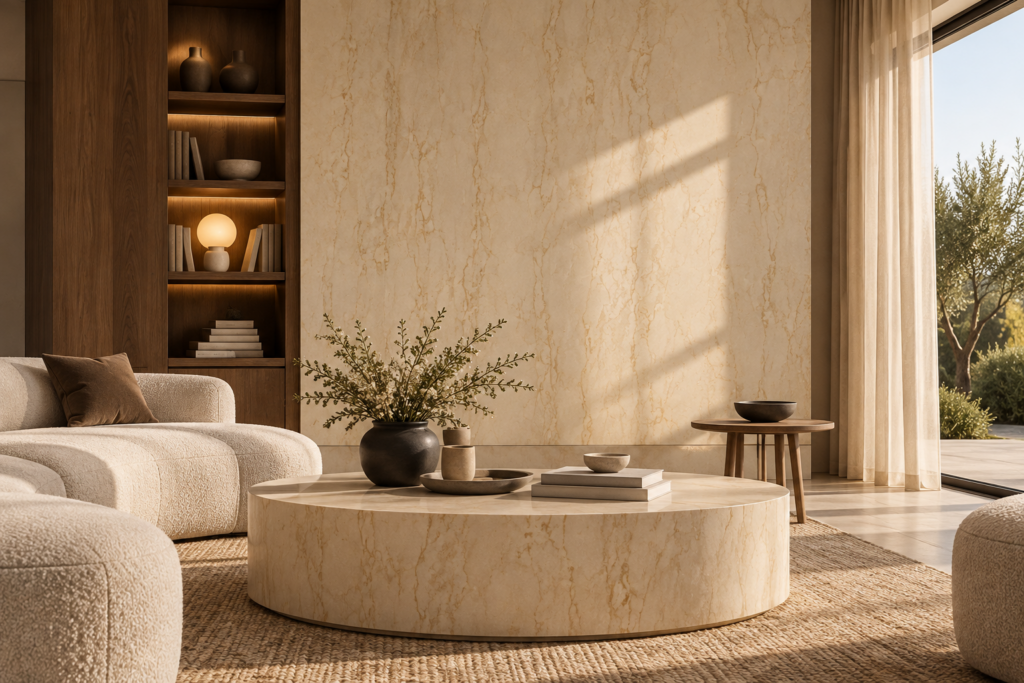
Warm creams, earthy browns, walnut, bronze and off-white can sit together without perfectly matching. A surface with subtle movement can become the link between these elements, carrying several tones while allowing furniture, lighting and objects to retain their own identity.
Krest’s Amber Travertine, for example, brings a warm mineral character that sits naturally alongside timber, bronze and tactile fabrics. Its pattern introduces detail without demanding to be the loudest element in the room.
Does everything need to match?
Increasingly, no.
Material continuity does not have to mean repeating the same finish everywhere. It can come from selecting materials that share a visual language while retaining enough difference to make the composition interesting.
This shift has been developing for some time. Vogue’s exploration of interior design trends in 2025 reflected the wider movement towards interiors with greater individuality and character, a direction that has continued to evolve through 2026.
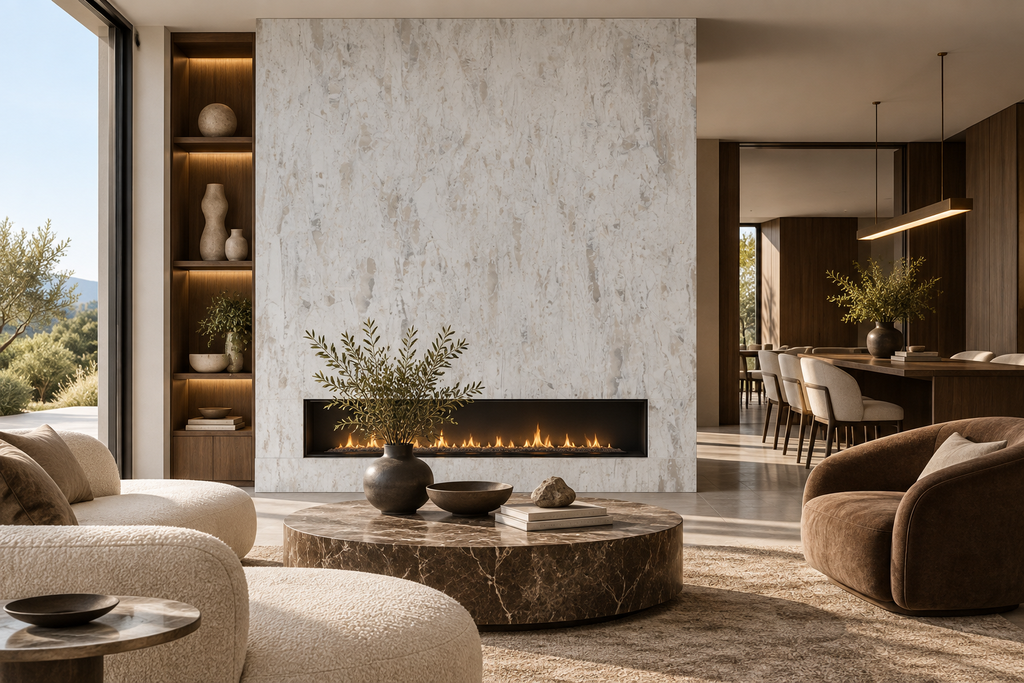
The cooler character of Oyster Glaze illustrates the idea differently. Against dark timber, warm neutrals, bronze detailing and softer furnishings, its layered pattern creates contrast while remaining calm enough to work at architectural scale.
This also suggests a broader role for engineered quartz. Rather than stopping at the worktop, slim surfaces can allow material character to move vertically into feature walls and other appropriate interior applications.
Where does quartz fit into the new material mix?
Perhaps the more useful question is: where can it take us next?
Quartz has traditionally been associated with kitchens for good reason. Its non-porous surface, scratch resistance, durability and straightforward maintenance make it particularly suited to spaces designed for everyday use.
But the design conversation has moved forward.
With broader palettes, warmer colours and increasingly expressive patterns, engineered quartz can now participate in the material conversation traditionally associated with natural stones such as marble and granite, while bringing the consistency and practical characteristics of a manufactured surface.
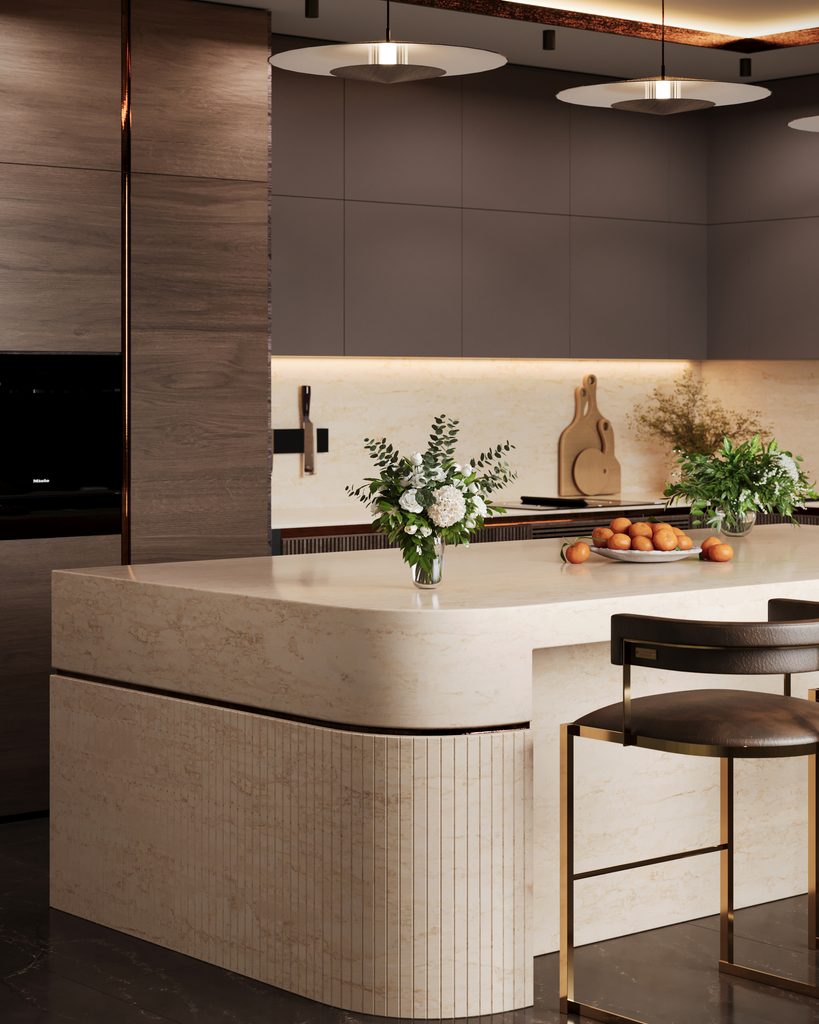
Krest extends that flexibility through surfaces from 12 mm through to 20 mm and 30 mm, with Jumbo and Super Jumbo formats creating further possibilities for larger applications. Amber Travertine demonstrates the versatility particularly well: the warm character seen within a living environment transitions naturally into a kitchen, where quartz takes on a more functional role across worktops, islands and splashbacks.
For designers working within considered specification parameters, that combination matters: visual choice, practical performance, dimensional flexibility and the ability to build a coherent material identity across more of a project.
A more interesting kind of harmony
The new material mix is not about adding more for the sake of it. It is about choosing materials that make one another more interesting.
Quartz does not need to imitate timber, metal, textiles, marble or granite. Its opportunity lies in sitting confidently among them.
And perhaps that is where contemporary interiors become most compelling — not when everything matches, but when everything belongs.

