
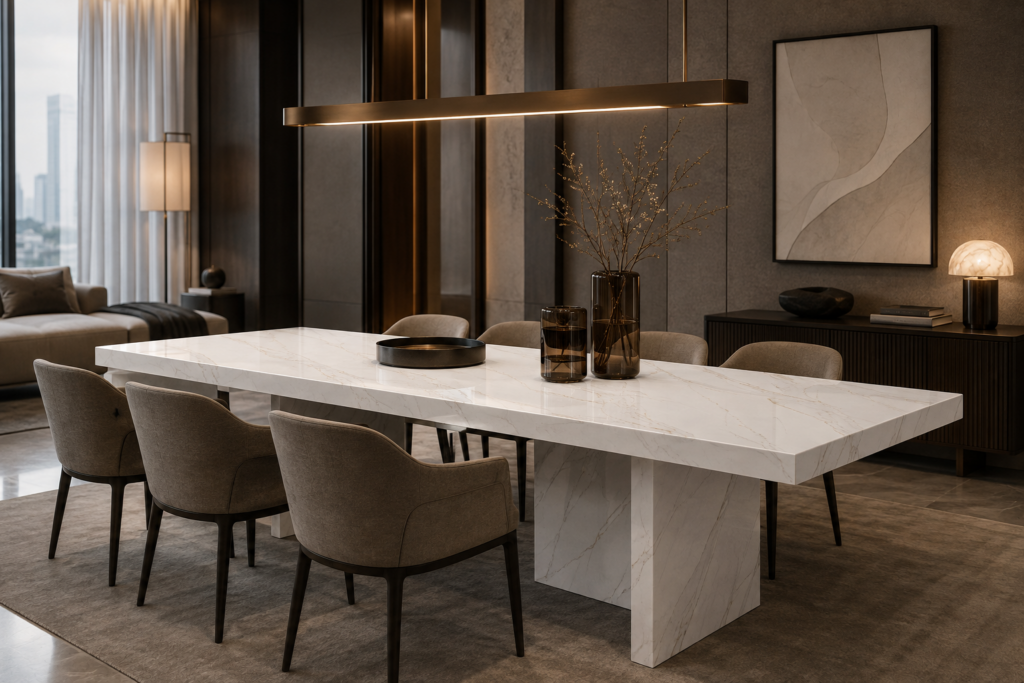
Why Quartz Is Quietly Redefining Contemporary Furniture Design
For many years, engineered quartz earned its reputation in the spaces where performance mattered most. Kitchens, bathrooms and commercial worktops became its natural territory, valued for combining visual consistency with durability and ease of maintenance. Those applications remain important, but they no longer define the material’s full potential. Across contemporary interiors, quartz is moving beyond the surfaces people expect to see and into the furniture that gives a space its character.
Luxury interiors are increasingly designed around permanence rather than decoration. Instead of filling rooms with many unrelated objects, designers are selecting fewer pieces with greater visual and functional importance. A console table can establish the tone of an entrance. An executive desk can define a workplace before a conversation begins. A bench or coffee table can connect colour, proportion and light across an entire room. Furniture is no longer simply added after the architecture is complete. It is becoming part of the architecture itself.
Furniture Is Becoming Architecture
This change is closely connected to the way leading furniture brands and designers approach materiality. The influence of companies such as Minotti, Poliform, Molteni&C, Giorgetti and Henge can be seen in interiors where furniture, cabinetry and architectural surfaces belong to one coherent language. Timber provides warmth, metal brings precision, leather adds tactility and stone introduces permanence. Engineered quartz now offers designers another way to create that sense of continuity, particularly when a project requires both visual impact and reliable everyday performance.
Its appeal lies partly in design freedom. Contemporary quartz ranges extend from quiet mineral tones and fine veining to saturated colours and expressive movement. A pale, delicately veined surface can support an understated scheme, while a vivid red or green can turn a functional object into a focal point. Because the material is manufactured in slabs, designers can study pattern direction, edge profiles and junctions before fabrication begins. This allows the finished furniture to feel deliberate rather than applied.
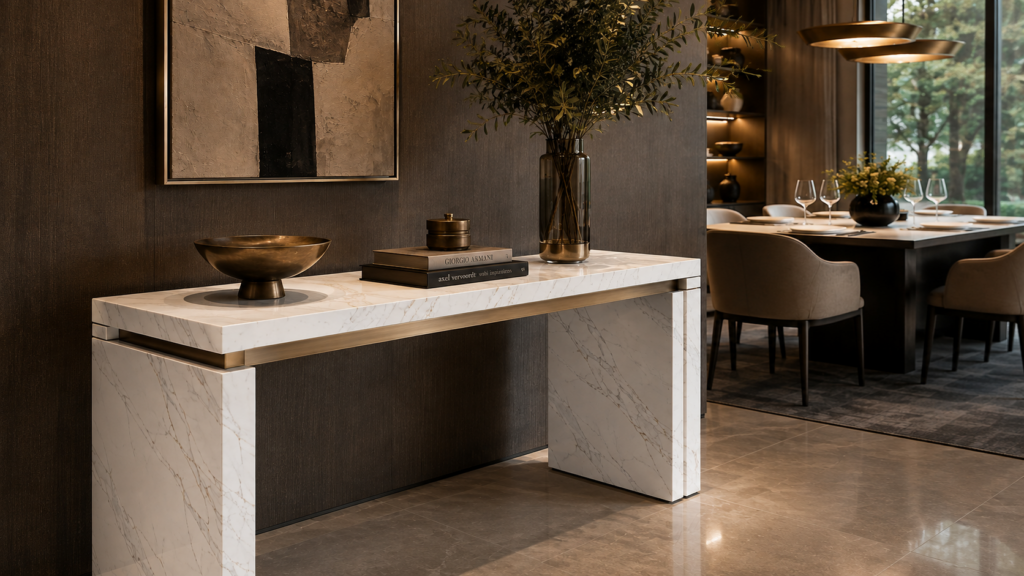
Figure 1 | Palatial Collection, Calacatta Colorado. A console table that gives a functional entrance piece the presence of an architectural element.
The Calacatta Colorado console illustrates this shift particularly well. Its restrained veining allows the form to remain elegant, while the stone surface gives the piece architectural presence. In an entrance hall, hotel suite or private residence, a console of this kind does more than hold objects. It frames the first impression of the interior and establishes a material reference that can continue through other areas of the project.
Beauty That Works Harder
The growing interest in quartz furniture is not driven by appearance alone. Furniture is touched, used and cleaned more frequently than many fixed architectural elements. A desk must accommodate laptops, books, writing tools and daily movement. A coffee table may encounter drinks, food and decorative objects. A bench in a hospitality or residential setting must continue to look refined after repeated use. For designers and clients, this creates a simple requirement: a statement piece must also work hard.
Figure 2 | Maven Collection, Lustre Red. The executive desk combines a strong visual identity with a surface intended for regular daily use.
Engineered quartz is scratch resistant under normal interior use, helping desks, tables and consoles retain their finish when used responsibly. Its non-porous surface does not require routine sealing and makes day-to-day cleaning straightforward. That same low-absorption quality supports stain resistance against many common spills, although prompt cleaning and the manufacturer’s care guidance should always be followed. These characteristics are especially valuable in hospitality, workplace and high-use residential settings, where maintenance must be considered from the beginning rather than after installation.
The surface is also hygienic because its non-porous nature makes it less likely to absorb moisture and residues. This does not remove the need for regular cleaning, but it gives designers confidence when specifying furniture for dining, reception, bedroom and workplace environments. Quartz also offers resistance to moderate heat; however, it should never be described as heat proof. Very hot cookware or appliances can create thermal stress, so trivets, pads and sensible detailing remain essential.
The Lustre Red executive desk demonstrates how performance can support, rather than dilute, creative ambition. Its deep colour gives the room authority, while the scale of the surface turns a practical workstation into the defining element of the interior. The material allows the designer to create a strong visual identity without choosing a delicate finish that would be difficult to maintain in daily use.
From Concept to Fabrication
Successful quartz furniture depends on collaboration. The designer may define the form and visual intent, but the fabricator determines how that idea can be realised safely and precisely. Thickness, weight, support, joint placement, edge treatment and fixing methods must all be considered. Quartz is strong as a surface material, yet furniture should not rely on the slab alone where structural loading is involved. Internal frames, concealed reinforcement and carefully engineered bases may be required, particularly for long spans, cantilevers or slender profiles.
This is where experienced fabricators and distributors become design partners rather than only suppliers. Early discussion can help determine suitable slab orientation, practical dimensions, transport access and installation sequencing. It can also prevent avoidable problems such as unsupported overhangs, weak cut-outs or unnecessary material weight. When timber, brass, steel or leather are introduced, the junction between materials must be resolved with equal care so the furniture feels refined from every angle.
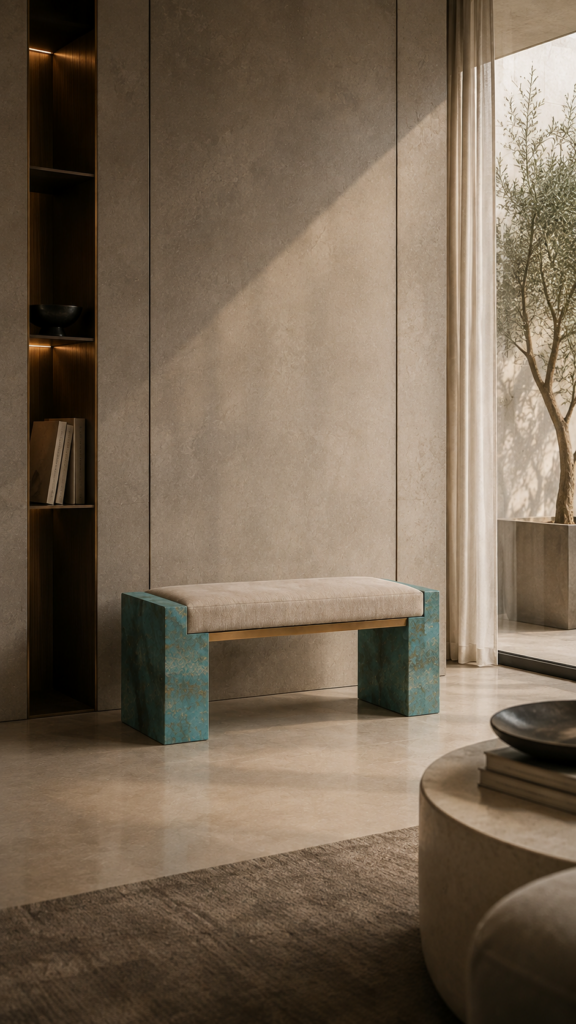
Figure 3 | Aura Collection, Amazonite. Expressive pattern and careful fabrication turn a simple bench into a distinctive furniture statement.
The Amazonite bench shows how quartz can be combined with a simple architectural form to create something both useful and memorable. The expressive surface becomes the visual identity of the piece, while its proportions remain calm enough for a luxury interior. For a distributor, this type of application broadens the conversation beyond kitchen supply. For a fabricator, it creates an opportunity to demonstrate craftsmanship. For the designer, it opens a wider palette of colour and pattern for furniture that may be unique to a project.
Looking Beyond the Kitchen
Quartz furniture is increasingly relevant across luxury residences, boutique hotels, executive offices, reception areas and premium retail. In these settings, the material can help connect fixed architecture with movable or bespoke elements. A quartz used on a reception counter might reappear on a side table. A surface introduced in a bathroom vanity may continue into a bedroom console. Repetition does not have to mean uniformity; used selectively, it creates rhythm and strengthens the identity of the scheme.
For architects and interior designers, this continuity can simplify a complex material palette. For distributors, it creates new specification opportunities around furniture, joinery and hospitality fit-out. For fabricators, it encourages closer involvement at concept stage, where technical knowledge can improve both the design and the final installation. The value therefore extends beyond the finished object. Quartz furniture can become a point of collaboration across the whole project team.
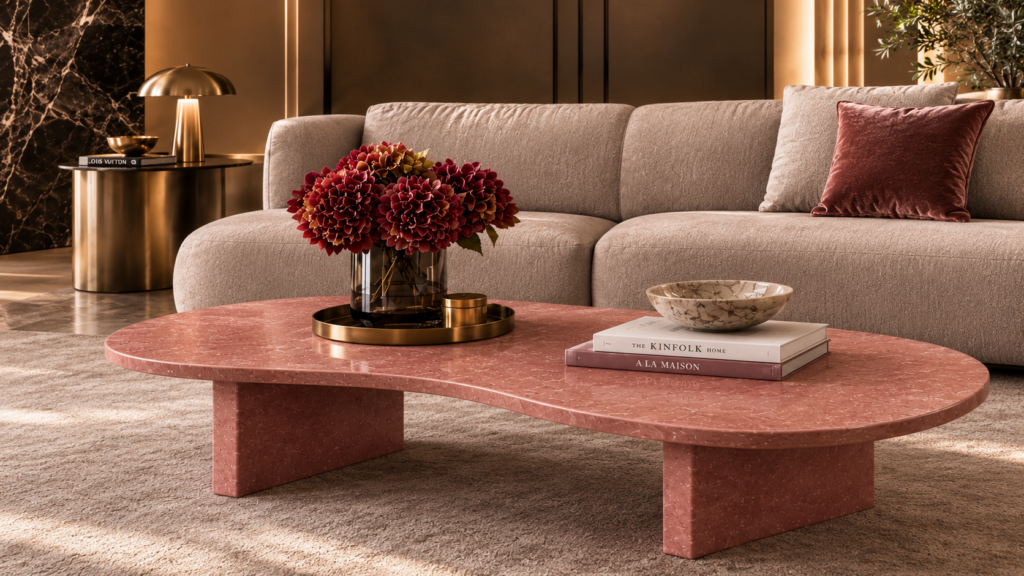
Figure 4 | Maven Collection, Lustre Red. A familiar furniture form becomes a focal point through colour, proportion and material continuity.
The Lustre Red coffee table represents the most expressive end of this movement. Its colour turns a familiar furniture type into a statement, but the piece remains functional and proportionally grounded. This balance is central to the future of material-led interiors: furniture should attract attention for the right reasons, while continuing to serve the people who use it.
A Designer’s Reflection
Every generation of designers discovers materials that quietly reshape the way spaces are conceived. They matter not because they demand attention, but because they solve problems beautifully. Quartz has already transformed expectations in kitchens and bathrooms. Its growing role in furniture suggests a wider possibility.
As furniture becomes more architectural, material choice becomes part of the story people experience every day. A desk, console, bench or coffee table can carry colour, durability, craft and identity in a single form. Perhaps that is the most meaningful measure of good design: not simply how a material looks when it is installed, but how naturally it belongs, how confidently it performs and how well it continues to serve the space over time.

